
Why are questions the most powerful tool in innovation?
Questions are the most powerful tool in innovation because they get past what a team assumes and down to what a customer actually needs. A great question is open-ended, free of judgement, and dares to be answered. It stings, because forced introspection always stings, and that sting casts out the demons of your own assumptions. Ask why enough times and a symptom finally admits it was never the problem.
In my role as a coach, questions help me to understand why people behave as they do, to identify desired outcomes, and to inspire people to consider new possibilities. It is the tool of tools, a behavior unto itself that can widen horizons like a fish-eye lens, then narrow them with surgical precision. I have witnessed profound epiphanies triggered by a single question. My daily quest is to witness the next one.
The Art of Questioning
Great questions are inherently honest and free of judgement, opinion, and emotion. They are a gauntlet across the cheek and dare to be answered. As such they come with the requisite sting of forced introspection. But with that sting comes the catharsis of casting out the demons of your own assumptions. They are open-ended and give the gentlest soul a chance to sing. They open up a world of possibilities and bestow permission.
Poor questions manipulate people. They ask about the hypothetical, and get hypothetical answers as a result. They're leading, and get exactly what they wanted to hear. They're loaded and bully people into agreement. They're closed-ended and afraid of an unexpected answer. They narrow opportunities and imply prejudgment. They are the worst kind of maudlin theatre; written to indulge the actors, but leaving the audience longing for meaning and demanding a refund.
Getting to the root of why people behave as they do in our dynamic world requires a curious mind that reflexively asks questions when faced with ambiguity. Once, I asked a project team about the root cause of their customer's problem. Their response was something that sounded more like a symptom than a cause. I asked, "why?" several more times, with answers that got closer and closer to a root cause. Finally, I asked, "Solving which problem will provide your customer with lasting value?" In that moment, they courageously shifted their focus. Solving for the symptom was quick and easy. Solving the root cause problem was harder and uncomfortable. But it was a path that truly inspired the team and led to a lasting solution that improved the lives of their customers.
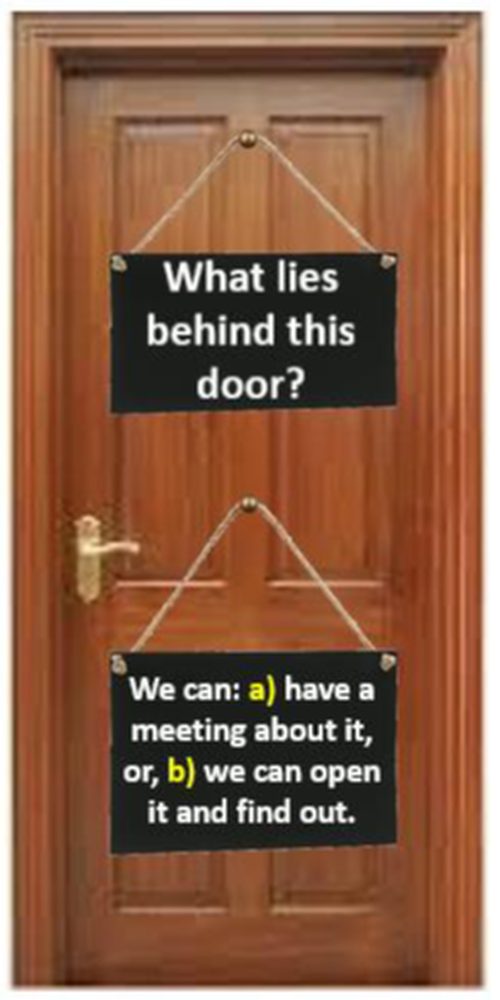
Questions That Provoke Action
My Favorite Questions:
- "What is the customer outcome that you are trying to solve for?"
- "How could you test that assumption?"
- "What evidence do you have?"
- "Solving which problem will provide your customer with lasting value?"
- "What questions could have saved [company name]?"
My favorite questions provoke action: "What is the customer outcome that you are trying to solve for?", "How could you test that assumption?", and "What evidence do you have?". Questions like these often frustrate people because, to answer them, they will have to go about their work from a different angle. That frustration melts away when their work de-risks the path forward with behavioral evidence. For most, there's no going back to waterfall work.
Critics say that all these questions slow down their work. But if the work lacks evidence, what are you working toward? What questions could have saved Kodak? Blockbuster? Sears? Or a project you're working on right now?
Questions are powerful tools of discovery and growth; and drivers of creativity and impact in the lives of others. Today, I challenge you to ask a question in a situation where you might be tempted to state a personal opinion or lean on an assumption.
What Separates a Great Question From a Poor One
A great question is honest and free of judgement, opinion, and emotion. It is open-ended, it dares to be answered, and it hands the quietest person in the room permission to say something you did not expect. A poor question does the opposite. It steers, and it collects the answer the asker already had in mind.
- Open-ended, not closed: a closed question is afraid of an unexpected answer. An open one gives the gentlest soul a chance to sing.
- Honest, not leading: a leading question gets exactly what the asker wanted to hear. That is not evidence. That is an echo.
- Neutral, not loaded: a loaded question bullies people into agreement and implies you have already judged.
- Real, not hypothetical: ask about the hypothetical and you get a hypothetical answer back.
- Opening, not narrowing: great questions widen the horizon first, then narrow it with precision. Poor ones only narrow.
How to Ask Your Way to a Root Cause
Here is the sequence I follow when a team hands me a problem that sounds a little too tidy.
- Ask what outcome the customer is solving for. Start at the customer, not at the feature.
- Listen for a symptom wearing a cause’s coat. Tidy answers that arrive fast are usually symptoms.
- Ask why. Then ask it again. Each round moves the answer closer to a cause.
- Ask which problem delivers lasting value. “Solving which problem will provide your customer with lasting value?” is the question that makes a team choose the harder road.
- Ask for the evidence. “How could you test that assumption?” and “What evidence do you have?” turn a preference into behavioral evidence.
Expect resistance somewhere around the third why. Answering these questions means working from a different angle, and that is uncomfortable right up until the evidence shows up. Which step does your team skip?
Frequently asked questions
What makes a great question?
A great question is honest and free of judgement, opinion, and emotion. It is open-ended, so it gives the gentlest soul on the team a chance to sing, and it bestows permission to answer in a way you did not expect. It also stings a little, because it forces introspection, and that sting is what casts out the demons of your own assumptions.
What makes a question a bad one?
A bad question manipulates the person answering it. Leading questions collect exactly what the asker wanted to hear, loaded questions bully people into agreement, and closed-ended questions are simply afraid of an unexpected answer. Ask about the hypothetical and you get a hypothetical answer back. Bad questions narrow opportunity and imply you have already made up your mind.
How do you get to the root cause of a customer's problem?
Keep asking why until the answer stops sounding like a symptom. I once asked a project team for the root cause of their customer's problem and got back something that sounded more like a symptom, so I asked why several more times and the answers got closer each round. The question that finally turned them was, “Solving which problem will provide your customer with lasting value?” Solving the symptom was quick and easy; solving the root cause was harder and uncomfortable, and it was the path that improved their customers' lives.
What questions should I ask my innovation team?
Start with the three that provoke action: “What is the customer outcome that you are trying to solve for?”, “How could you test that assumption?” and “What evidence do you have?” Expect some frustration, because answering them means going at the work from a different angle. That frustration melts away once the work de-risks the path forward with behavioral evidence. For most teams, there is no going back to waterfall after that.
Do all these questions slow the team down?
Questions cost less time than building the wrong thing. Critics say the questions slow the work down, but if the work lacks evidence, what are you working toward? Ask what questions could have saved Kodak, Blockbuster, or Sears. Then ask what questions could save the project on your desk right now.
Ready to Transform Your Team with Better Questions?
Get personalized coaching to apply these principles to your specific innovation challenge. Start with a free 15-minute consultation.