
Why do most innovation ideas fail?
Most innovation ideas fail because they start as solutions, not problems. We were taught to think on our feet and answer fast, so we hand a logical fix to an emotionally-charged problem the customer may not care about, can already solve without hardship, or will never pay to fix. Start with the problem instead. Understand it better than your customer does, and you'll have the insight required to provoke action.
Most of your ideas are solutions—mine too. That may sound good, but it isn't. But it's not our fault. We were taught to think on our feet, come up with quick solutions, and act. It's what gets us recognized. But it's wrong. Our solution ideas, mine and yours, aren't the solution.
Think about the odds against us:
- We're not the customer to begin with!
- Our solution idea is a logical answer to an emotionally-charged problem
- The problem isn't as big as we think it is
- The customer can solve it themselves without hardship
- It's actually a business problem, so our external customer doesn't even care about it
- The customer isn't willing to pay to solve it
- Our solution doesn't solve the root cause problem
- Our solution would arrive too late to matter
I could go on, but you get it.
In learning about the work people do, I often ask, "So who is your customer, what problem are you solving, and how do you know that this problem is worth solving?" Too often, those questions are met with frustration. We're tasked with coming up with solutions, when we really need to understand problems and outcomes. But we're not equipped to do it if we are working in the traditional way.
"So," you ask, "what am I supposed to do? I'm paid to solve problems!"
I hear you. First, get all the solutions out of your team's heads. Put them up on the wall in a parking lot for later. Now with a clear head, start with the problem. Your job is to understand it better than your customer. When you do, you'll have the insight required to provoke action. There just isn't any way around this. But it doesn't have to take forever. What can you learn about your customer and how the problem you're trying to solve impacts them? What can you learn about the outcome they want? Remember, outcomes aren't solutions. Outcomes are what happens as a result of the solution; in sales parlance, the benefit of the feature. What is your customer doing now to solve? How is that working? Does your customer care enough to even try a different solution?
In 2019, I spent time with a team that had a perfectly logical solution that they wanted to create. But the cost of the solution is possibly greater than the benefit that the customer and the Enterprise would ever get from the solution. Like an order of magnitude, or two, greater. The cool thing is that the team accepts this, and is spending their time sizing the opportunity and putting some real financials to it. They've even identified existing opportunities that may indirectly drive results without additional investment. Smart!
Once you understand the scale of the problem and what your customer is trying to achieve, you can identify the behaviors your customer would have to be willing to engage in to get that outcome. Now you can try some of your solutions in the parking lot, but in a simple way to test the behavior, not the solution itself. The goal is to see if your customer will behave in a way through which we can deliver value. If they won't, that's OK. You just got the evidence you need to do something else. It's not failure, by the way. Failure is spending a lot of money to build something no one wants. Anything else is success.
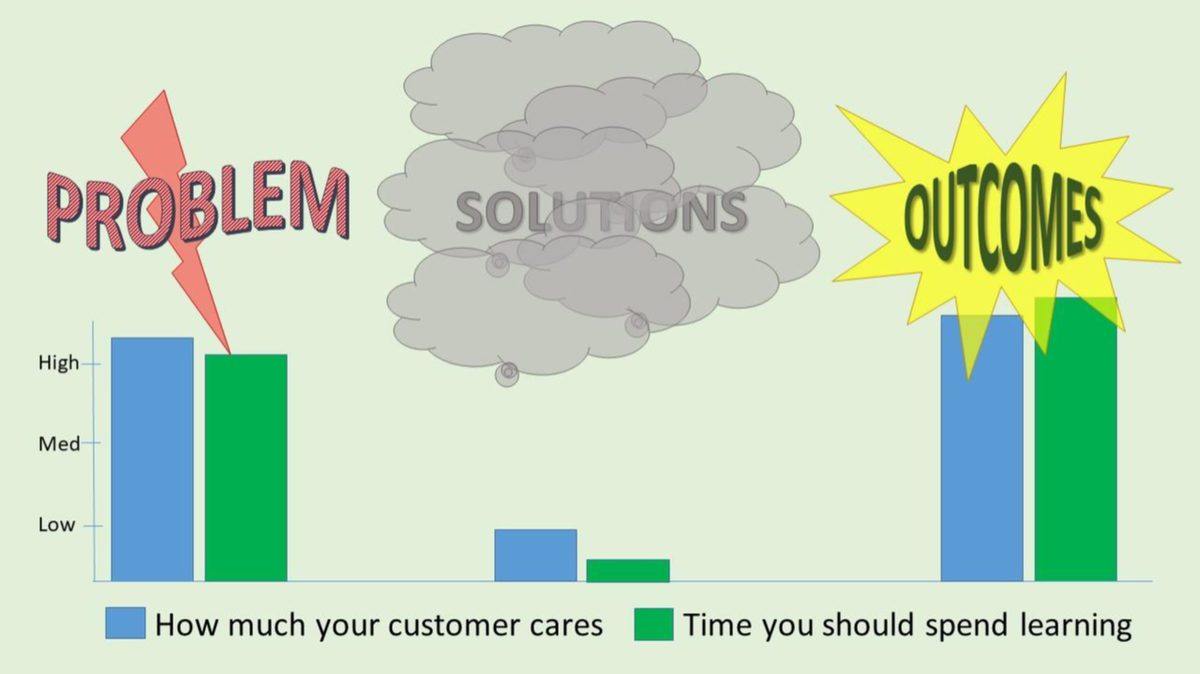
Solutions clumsily look for problems. Insights reveal outcomes; the real thing that activates a customer. Solutions are cheap and plentiful like water. When you fall in love with a solution you become detached from the problem and your customer. Insights are rare like diamonds, and there is requisite work to find them. But when you fall in love with a problem, you become agnostic to solutions—just like your customer.
Problem, Outcome, Solution: Which Is Which?
Three words get traded around as if they meant the same thing. They don't, and that confusion is where most ideas go to die.
- Problem: what your customer is struggling with today and what it costs them. Your job is to understand it better than they do.
- Outcome: what happens as a result of the solution; in sales parlance, the benefit of the feature. Outcomes activate customers. Solutions don't.
- Solution: the thing you build. Cheap and plentiful, and worth nothing until a problem and an outcome have earned it.
How to Start With the Problem
Here's the order of operations. It doesn't have to take forever.
- Empty the room. Get every solution out of your team's heads and park them on the wall for later.
- Name the customer. Who are they, what problem are you solving, and how do you know that problem is worth solving?
- Size the problem. What is your customer doing now to solve it? How is that working? Would the cost of your solution swamp any benefit the customer and the Enterprise would ever get from it?
- Find the outcome. What is your customer trying to achieve? Remember, outcomes aren't solutions.
- Name the behavior. What would your customer have to be willing to do to get that outcome?
- Test the behavior, not the solution. Pull an idea out of the parking lot and run the simplest test that shows whether your customer will behave that way. If they won't, you have your answer, and it's a good one.
One question before you build anything: do I understand this problem better than my customer does? If the answer is no, you're not ready.
Frequently asked questions
How do I know if a problem is worth solving?
Ask what your customer is doing about the problem right now, and how well that's working. If they can solve it themselves without hardship, or they won't pay to have it solved, the problem isn't worth your investment no matter how good your solution is. A problem worth solving is one your customer cares about enough to try something different.
What should my team do with the solution ideas we already have?
Park them. Get every solution out of your team's heads and put them up on the wall in a parking lot for later. With a clear head you can start with the problem, and the ideas will still be sitting there when you're ready to test the behavior behind them.
What's the difference between an outcome and a solution?
An outcome is what happens as a result of the solution; in sales parlance, the benefit of the feature. The solution is the thing you build. The outcome is what your customer actually gets, and outcomes are what activate a customer, so understand the outcome they want before you decide what to build.
How do I test an idea without building it?
Test the behavior, not the solution. Once you understand the problem and the outcome your customer wants, name the behaviors they would have to engage in to get that outcome, then run the simplest test that shows whether they'll do it. The goal is to see whether your customer will behave in a way that lets you deliver value.
Is it a failure if customers don't want my solution?
No. Failure is spending a lot of money to build something no one wants. Anything else is success. When a customer won't behave the way your solution requires, you haven't lost anything — you've got the evidence you need to go do something else.
Why are customer insights more valuable than ideas?
Solutions are cheap and plentiful like water. Insights are rare like diamonds, and there is real work required to find them. Fall in love with a solution and you become detached from the problem and your customer. Fall in love with the problem and you go agnostic on solutions, just like your customer.
Ready to Test Your Ideas the Right Way?
Get personalized coaching to apply these principles to your specific innovation challenge. Start with a free 15-minute consultation.